 Tony Passwater
Special Holiday Issue
Navigating Year-End Tax Rules, S-Corp Audits & Cloud Hosting Benefits
We want to wish you and your family a wonderful holiday season. As your business prepares for its annual closing, staying on top of critical tax updates is vital. In this issue of our Small Business Quick Reads, we break down essential tax adjustments, audit landmines for S-Corp owners, S-Corp officer compensation traps, and how cloud hosting is changing remote access for collision repair shops.

As we get to most businesses’ yearend, making sure your books are “clean” becomes a much higher priority than during the rest of the year.
We specialize in getting your books “clean” and restructuring your accounts so you can get timely and valuable financial insights about your business at the end of each month. So many business owners typically wait until their CPA or Accountant does yearend tax returns to see “How they did last year”. You don’t need to—and should not—run any business this way!
Please keep in mind, CPAs and Accountants are focused on just your tax liabilities and not your business operations. This is where we have assisted many collision repair businesses as well as other small businesses get this under control … the way it should be.
Let’s make this upcoming year your most profitable and secure yet!
Tony Passwater
IRS Clarification: PPP Loan Covered Expenses Only Deductible If Loan Not Forgiven!
As federal, state, and local governments pass legislation and offer guidance in response to various economic relief cycles, we are continuing to monitor the landscape to provide helpful information to you and your business.
The IRS and U.S. Treasury Department released critical guidance pertaining to the Paycheck Protection Program (PPP) to clarify how to deal with covered expenses for a PPP loan that is not forgiven in the year it was received:

What does “PPP loan expenses are only deductible if a loan is not forgiven” mean?
It means if you used the monies you received for the PPP Loan correctly, the loan will be forgiven, but those expenses you paid which would normally reduce your net profit and tax liability, are not deductible. For many businesses, this may cost more than expected, and represents a significant hurdle in structural tax planning.
At this time, this is the IRS position on forgiveness, but Congress can change this through legislation. We continue to monitor Capitol Hill closely for any structural updates.
There is also some confusion on when the deadline for applying for forgiveness applies. Borrowers may submit a loan forgiveness application any time before the maturity date of the loan, which is typically either two or five years from loan origination.
However, if a borrower does not apply for loan forgiveness within 10 months after the last day of the borrower’s loan forgiveness covered period, loan payments are no longer deferred, and the borrower must begin making payments on the loan. For example, a borrower has up to 10 months from the close of their covered period to apply for forgiveness before loan repayment begins.
Also, the expiration date in the upper-right corner of the posted PPP loan forgiveness application forms has been providing some confusion as well. These dates are displayed for purposes of SBA’s compliance with the Paperwork Reduction Act. It reflects the temporary expiration date for the approved use of the forms. This date will be extended, and when approved, the same forms with the new expiration date will be posted.
📊 Run a Forgiveness Analysis with ADPrun
Estimate your exact loan forgiveness potential using our ADPrun payroll integration portal.
Tax Laws and Some Key Changes Affecting Your Business
The complications involving tax law are an ever-changing landscape. Many may not affect your business but there are many that can cause additional tax liabilities and even audits. Some, you may not be aware of until your CPA sends you your tax returns, but then it is too late!
These can be usually avoided with just a little tax planning and a review of how your financials are being accounted for in your accounting system such as QuickBooks. It also makes sense to do this the right way to minimize the chance of an IRS audit.
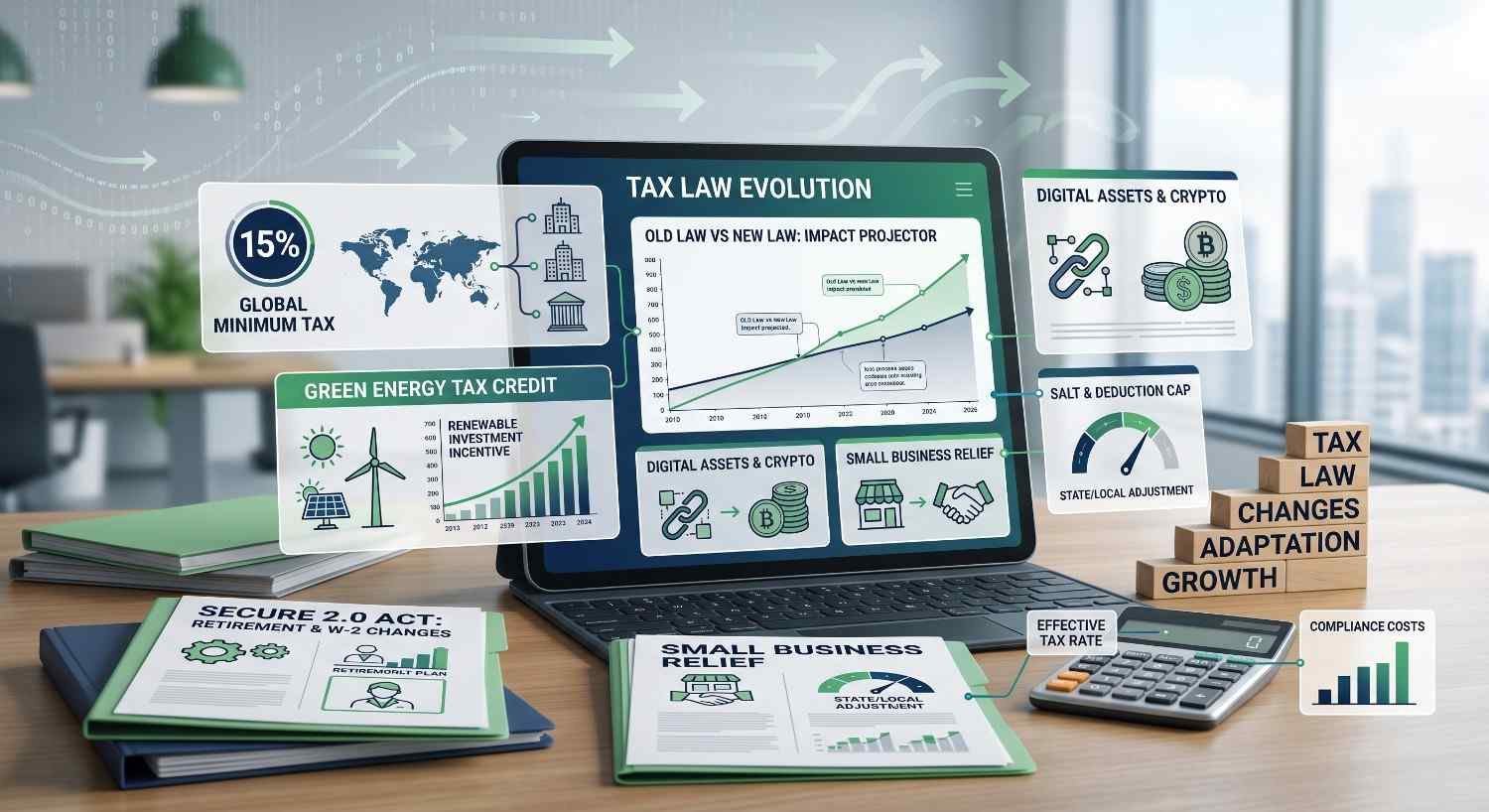
Officer Compensation: One area that often can be an issue if your business is an S-Corp revolves around the Officers’ Compensation and how medical and other insurances paid by the company are accounted for.
If you are an officer of the corporation, you are required to take a reasonable salary reported on a W-2. This determination of “reasonable” is where many have gone wrong. Since any distributions (draws against profits) you take are only subject to income taxes and not Social Security or Medicare Taxes, the IRS is very particular about the ratio between your distributions versus salaries.
There is no doubt it is advantageous to take distributions since it overall saves your company over `$15\%$` versus paying salaries to officers, but this is where many have failed the tests, and when an audit is triggered, additional taxes, penalties, and interest may cost your business a great deal.
In addition, if you own the property and buildings “personally”, and your company pays rent to you, this also can be a problem area as well. Rents too, are only subject to income taxes as distributions, but they too need to be in line with comparable property/building rent in your market.
Being an S-Corp can offer some great tax savings for you and your business, but the combination of the above three income streams must be carefully and accurately set, or they may be disallowed.
Officer Insurances/Benefits:
Any stockholder that owns `$2\%$` stock or more must report many benefits such as medical, dental, vision, as well as some other insurance as income directly on their W-2 forms. This is often overlooked and the IRS has begun to look at this more frequently, triggering audits.
In our comprehensive S-Corp compensation guide, we covered these important considerations that S-Corp officers should prepare for. Check it out by Clicking Here.
Meals/Entertainment Deductions Have Changed!
I have not met a small business owner that does not believe that when they drive to a parts store, business meeting, or client event that when they stop and eat or buy meals for the employees, they are an expensable business expense. Well, that changed significantly under the Tax Cuts and Jobs Act (TCJA).
Basically, the TCJA eliminated the deduction for any expenses related to activities generally considered entertainment, amusement, or recreation. It also limited the deduction for expenses related to food and beverages provided by employers to their employees.
You can review a great, detailed tax law chart showing the common areas that you will need to be aware of. This TCJA comparison chart can be viewed by Clicking Here.
This as usual is a somewhat complex change that with careful adjustments in your accounting processes will not cause your business greater tax liability or audits. Contact us for additional information and support.
Don’t Miss the Early Bird Registration Deadline!
Register early for our upcoming winter programs to receive an exclusive $100 discount!

Business Value Spotlight: Cloud Hosting Solutions
If you are a QuickBooks user, I am sure either you have thought about moving to QuickBooks Online for the key reason of easy remote access. If you have already switched to QuickBooks Online, it still is not too late to change to a much better solution with better pricing.
The solution is what is referred to as Cloud Hosting and has been around for many years, but simply either was not price-competitive for small business, or the internet was just not very reliable.

What is Cloud Hosting?
Simply put … it is having your workstation on the internet in a very secure environment.
In the collision industry, we have set up and tested the inclusion of CCCone Management integrated into QuickBooks Desktop seamlessly. We have also set up Microsoft Office integration and OneDrive to share vehicle images for jobs in a well-structured system.
The cloud hosting solution is basically the installation of your purchased software with the license key on a network server which is hosted over the internet, allowing access from any corner of the world.
In layman’s language, the data and the software are stored on the cloud platform just like your photos are stored on Google or OneDrive, and the user with authentic login credentials can easily access the software using any device with internet access.
You can consider the cloud hosting as a mix of the desktop version integrated with the power of the cloud, giving you all the benefits of the online edition. This cloud solution has all benefits, but not the clunky, slow workflow of QuickBooks Online.
How does Hosted QuickBooks Desktop function on the cloud?
First, you provide your purchased software license key so it can be installed on their secure server.
After that, the user is given access to that particular server with certain configurations. The server being used by the user is protected with several bank-grade security measures so that it becomes a fully secured platform. In order to connect the end-user and the server, the Remote Desktop Protocol (RDP) is used which is later configured to log in as per the desired user. Changes are updated in real-time and automatically saved with nightly cloud backup services.
What advantages can I expect after choosing Cloud hosting?
✓
Anywhere, anytime remote desktop access
✓
High server uptime & bank-level encryption security
✓
Third-party application integration & scalable infrastructure
✓
Flexibility & cost-friendly pricing (typically less than QBO)
✓
Automatic daily backup and recovery solutions
✓
Additional app installs (CCCone Management Systems, MS Office)
✓
Real-time database updates & multi-user collaboration
What are the characteristics of a good cloud hosting provider?
Most of the leading cloud hosting providers have QuickBooks hosting as a part of their service, but in order to make the most from your cloud accounting decision and the software, you should always choose those cloud providers who have partnered with QuickBooks Experts. This way, you will have a better expert by your side that will have the required knowledge about the software as well.
This is a real game changer…
How much money can this save you on your bottom line?
Please contact us directly and we can explain these programs and connect you to the right provider to get you setup.

As Service Providers for the Collision Industry, we often find many valuable products and services for our clients… Here are a few we know you will get great value from and save you money at the same time.

PrintBoss Software: Elite blank-check printing integration into QuickBooks to lower print costs up to `$90\%$` and secure your operations.

PayProTec Merchant Processing: Excellent merchant fee solutions directly integrated with QuickBooks. Save up to `$95\%$` on fees.

Dell Workstations: Eliminate slow and unresponsive computers. Premium dual-screen high-performance setups at negotiated prices.

Critical Backup Solutions: Full-service, nightly encrypted cloud backups with manual restoration support to stop ransomware threat vectors.

AEII Web Hosting Services: High-security web server space and email accounts, fully managed and maintained locally for your peace of mind.
Our company AEII, QuickBooks R Us, is always here to assist any small business with a full range of services, and provide the training and support needed to achieve excellent results. We have assisted businesses worldwide … And we specialize in the collision repair and service industry. Schedule a free session to discuss any QuickBooks or small business needs you may have below:
📅 Book Your Free Session Now
Free 30-Min Consultation • No Obligation